A Review of a Historical Review: MoMA’s Role in the International Dissemination of a Continent’s Architecture. A Study of the Exhibition Latin America in Construction: Architecture 1955–1980
- Author: Felipe Reyno Capurro
- Type of research: PhD (Doctoral Thesis)
- Lines of research: Spaces and Types, Masters and Rethorics
- Director: Juan Coll-Barreu
- Defense: 2021 April
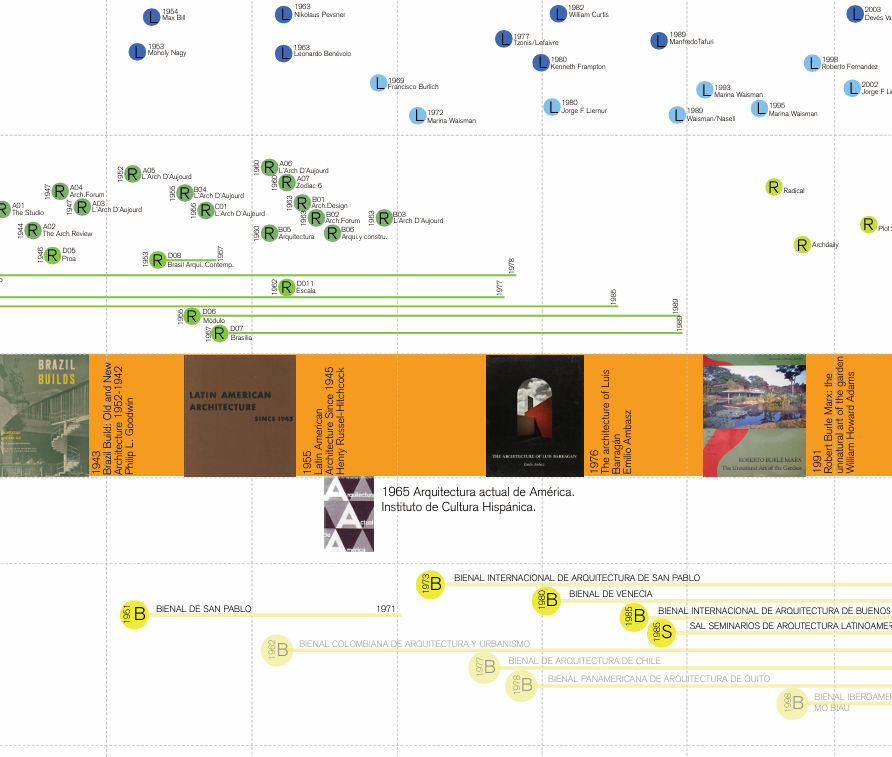
On March 29th, 2015, the “Latin America in Construction: Architecture 1955-1980” exhibition was inaugurated. An exhibition that, according to its curators, de¬monstrated the architectural and urban planning originality of a vast region, over a period of twenty-five years. The work involved a five-year research that activated the entire Museum of Modern Art in New York (MoMA) in the tasks of exploring, identifying and exhibiting over 825 original documents that had never before been collected in the same space. Curators Barry Bergdoll, Jorge Francisco Liernur, Carlos Eduardo Comas and Patricio del Real built a new discourse around Latin American architecture that linked professionals across the whole continent, creating a new epistemological basis for future research. This discourse led to contradiction with, and rethinking of, the reviews made by architectural historians during the previous century. In doing so, they added to international debate a historical period of a region previously overshadowed by other architectural ideas of greater interest and dissemination. This doctoral thesis makes a critical review of the exhibition, with the aim of en¬hancing and building different points of view around Latin American museography and architecture from 1955 through 1980. It is divided into six chapters: the first is an approach to the state of affairs of Latin American architecture in relation to MoMA’s historical exhibitions, from 1929 to present. The second is concerned with the Depart¬ment of Architecture’s policies, its most influential exhibitions, and the scarce attention received by Latin American architecture. The third chapter analyzes two specific exhi¬bitions, “Brazil Builds” (1939) and “Latin America since 1945” (1955), and their close relation with the US Department of State’s interests. In the fourth section, the cura¬tors’ role and the exhibition process methods are analyzed, identifying the selection criteria for the works on display. The fifth chapter examines the exhibition resources by studying the space and the arrangement of the works. The sixth chapter is a study of the reviews received by the exhibition, and its representation in digital media. Finally, the conclusions try to demonstrate the relationships between the several agents invol¬ved in the exhibition and the strategies deployed by MoMA in order to represent and disseminate the continent’s architecture. The thesis includes interviews with the curators, plans and elevations of the exhi¬bition, made expressly by the author. This content offers a deeper understanding and knowledge on the subject, which makes this theoretical-practical research a means to continue advancing in this broad and diverse field of work that encompasses ways of telling and disseminating Latin American architecture, historiography, museography and contemporary reviews.