Six Exhibitions: The Role of Galleries in Shaping Madrid’s Architectural Culture from 1974 to 1984
- Author: Esteban Salcedo Sánchez
- Type of research: PhD (Doctoral Thesis)
- Lines of research: Art, Architecture, Media
- Directors: Juan Herreros Guerra, Jacobo García-Germán
- Defense: 2023 March
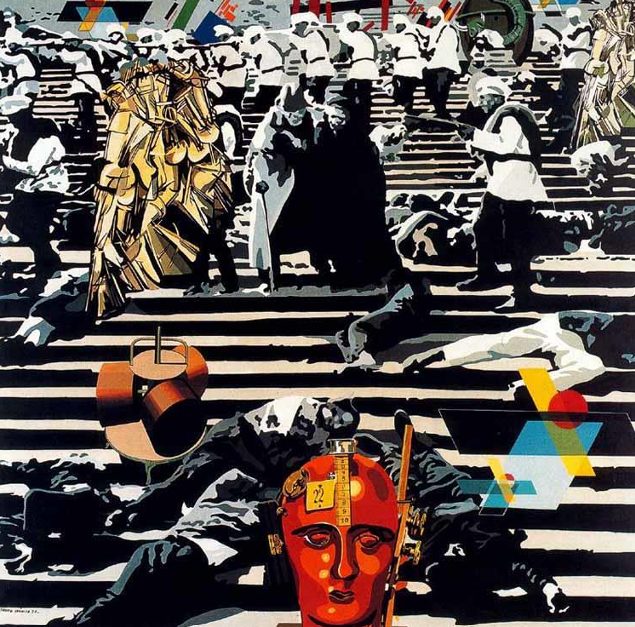
In mid-1970s Spain, with the end of the Franco regime, a new period of democratization began, known as the “Transition.” This process opened a decade of policies that strategically guided various Spanish cultural expressions, ranging from subversive to institutional.
In the field of architecture, the crisis of the modern movement and the emergence of a younger generation—who, through an interpretation of conceptualist postulates, advocated for the convergence of architecture, art, and design—promoted a series of exhibition practices that nurtured the cultural vocation of architectural work, especially in the capital.
The objective of this thesis is to demonstrate that architecture exhibitions, and the environments in which they took place, acted as mediation devices that directly intervened in what is called “the formation of Madrid’s architectural culture,” that is, the system of relationships and distinctive elements through which Madrid’s architecture was identified in parallel with the democratic transition process. In an initial phase, these exhibitions served as tools for transgression and counter-production of ideas (1974–1982), later becoming useful political agents in constructing a new image of the country abroad (1982–1984).
The continuation of cultural policies immediately following Franco’s death favored that the most relevant aspects of this cultural consciousness shift in architecture were channeled through galleries. Their blend of neutrality and cosmopolitanism allowed them to promote new modes of action and convergence among creators from different fields via a broad range of events and formats.
This intellectual conception of architecture, beyond the built object, marks the origin of postmodernity on the local scene and points to galleries as the places where crises of traditional architectural practice spaces—such as the School, the studio, or the Museum—were discussed.
The emerging postmodern sensibility critically shaped architecture in three ways: providing an alternative to the built project; exploring a new spatial and visual culture as discursive platforms; and contributing to the extension of the architect’s role beyond traditional limits by promoting their expansion into other fields, such as media, art, politics, and science.
As recent studies highlight, this new set of international relations and media awareness transferred to architecture exhibitions and associated publications, extending the image of Spanish architecture beyond national borders. This awareness ultimately activated these spaces as independent apparatuses for confrontation and meaning production, as research laboratories, or as representational stages.