Intimate Strangers: more-than-human subjectivities in architecture
- Author: Christina Ioannou
- Type of research: TFM MPAA (Master’s Thesis MPAA)
- Lines of research: Ecologies, Cities and Landscapes
- Directors: Mariacristina D’ Oria, Otro
- Defense: 2024 February
- Funding: Own funds
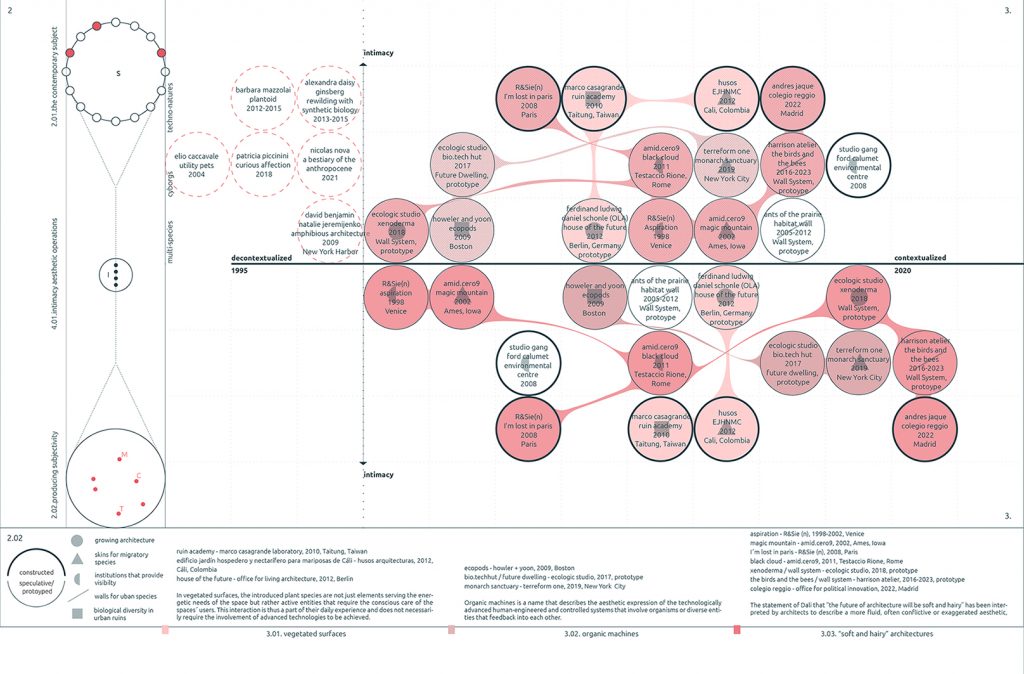
During the last decades, the unfolding new shapes of the concept of nature have strongly influenced the cultural and design fields, along with other factors such as diverse social interests and agendas. At the same time, opening up to other entities and new more-than-human approaches creates the space for developing enlarged definitions of the contemporary subject by certain streams of philosophy. Thus, recently coined notions such as ‘multi-species’ or ‘post-human’, enjoy a significant resonance in the design field as well. This research is concerned with those ideas of architecture that manifest socio-cultural approaches of the more-than-human and produce subjectivity for those agents, aiming to repair the relations between them and the built environment. After having drawn an argument posed by many thinkers, according to which this subjectivation of more-than-human through architecture aesthetically dissociates itself from merely technical or aesthetical forms of more-than-human involvement in the design, the study seeks to detect the socio-ecological bonds that unpack between humanity and more-than-humans in these emerging practices and to explore their possible associations to different aesthetic aspects. The research goes through multiple theoretical sources and artistic narratives to build an expanded definition of the contemporary subject, in order to analyse its materialisations in space. Subsequently, it uses several cases from the architectural discipline that experiment with interspecies practices in anthropized environments and challenge the strict boundaries between humanity and more-than-human, generating alternative social formations, albeit being developed in places involved in generalised capitalist and human domination processes. As a result, the research suggests three aesthetic categories named as follows: Vegetated Surfaces, Organic Machines and “Soft and Hairy” Architectures. It classifies in this way the various interpretations of nature that appears in urban architecture as more or less machinic, more or less aestheticized, more or less complex, and identifies aesthetic patterns nested in the forms of human and more-than-human entanglements. After that, it explores the possible instrumental use of the notion ‘intimacy’ for the navigation in those undertaking hybrid architectural formations, suggesting that subjectivation of more-than-human is related to distinct aesthetic operations of intimacy in each category. Margulis introduces the “intimacy of strangers” to describe the way species evolution in connection to one another, and the notion intimacy has surfaced again in the ecological discourse by Morton, as crucial for the generation of alternative formations between humans, technology and more-than-human organisms. Haraway revisits the writings of Margulis to describe a network in which earth entities are already involved and interlaced, where knowledge can be produced through grounded ‘multi-species’ practices of two-way domestication. In the final chapter, after an attempt to make a profound reading of the notion, the research analyses three case studies, each connected to one aesthetic category, to recognise the presence of aesthetic operations that architects use to generate intimacy. The aesthetics deriving from the first set of proposals serves as a tool for recording the forms of integration of what has been defined as contemporary subject. Intimacy suggests a new point of view from which to connect and define those forms. Through its capacity to create analogies of self-view in an alien presence of architecture, intimacy affirms its utility in explaining architectural operations.