Domesticity ‘Behind Bars’: Project by Rem Koolhaas/OMA for the Panopticon Prison in Arnhem (1979-1988)
- Author: Elena Martínez Millana
- Type of research: PhD (Doctoral Thesis)
- Lines of research: Habitat and domesticity
- Director: Andrés Cánovas Alcaraz
- Defense: 2021 June
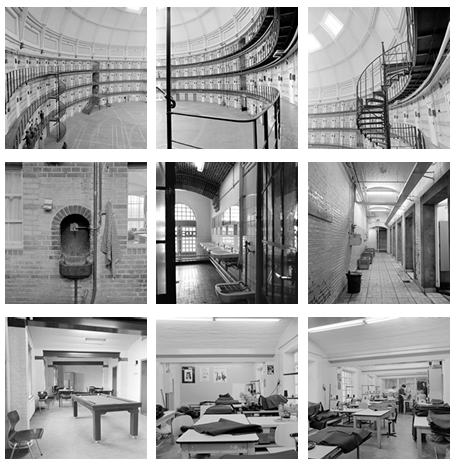
This doctoral thesis has set its focus on the project by Rem Koolhaas (Office for Metropolitan Architecture) for the renovation and the extension of the Koepelgevangenis (dome prison), located in the city of Arnhem, in the Netherlands (1979-1988). Its analysis shows that, even if it is a well-known project, scarcely has it been either studied or discussed. This investigation has proven that only its beginning was disclosed (1979- 1980), and that it was carried out over an entire decade (1979-1988). The hypothesis that has been developed has borne in mind that this project is one of the first of what is considered Koolhaas’ “first decade” as an architect (1979-1989), and that it was the first project he carried out in this phase without his OMA associate, Elia Zenghelis. The critical hypothesis has questioned up to what extent Koolhaas applied his (then) recent thesis present in Delirious New York (1978) with regard to “life in the metropolis” and the “Culture of Congestion” in the conception and design for the project of the Koepelgevangenis. Thus, the investigation has had the aim of examining —via the documents compelling the entire period of the study— how the project arose to transform the domesticity of the “dome prison” or Panopticon prison into a “Social Condenser” of the contemporary metropolis. To that aim, the thesis has been structured into two parts. In the first one, the better known aspects have been analysed, the initial project (1979-1980); in the second part, the unpublished or unknown aspects have been examined, the complete development of the project (1979-1988). The report of the initial study (1979-1980) determines, as if it were a “manifesto”, the strategy of intervention which, in spite of the variations Koolhaas introduced throughout the development of the project, remained invariable and which underlies throughout (1979-1988). This strategy operates on the “two fundamental principles” on which he had based his existence: central surveillance and solitary confinement, since they had both been “inverted” by “cultural changes”. Koolhaas made this relationship explicit by means of his own theoretical elaboration —the connection New York/De Koepel— via Hood, who “imagines and establishes on the floor patterns of human activity in unprecedented juxtapositions and catalytic combinations”, and the example of the Downtown Athletic Club, the “masterpiece” of the “Culture of Congestion”, a “Constructivist Social Condenser in Manhattan”. This matter has been proven in the analysis of the different phases of the development of the study and of the project. For example, with regard to its conception, it has been noted that Koolhaas warned about the fact that the prisoners could move “almost freely” through the rings of the Koepel, where the surveillance post had become a cafeteria for the guards. Thus, the strategy continues with the elimination of the Panopticon principle which had already taken place without the Koepel suffering alterations. Just like in the Downtown Athletic Club, the Koepel had been “conquered, floor by floor, by higher forms of social interaction”. Hence, that he suggested a “podium” —the public domain— which, in his initial proposal, also manifests in the Manhattan “grid” and the “satellites” of the Koepel —the “communal house”. With this analysis, it is possible to consider the role of the project for the Koepel in the first decade of Koolhaas/OMA, and to establish that Delirious New York constitutes the theory behind how it was designed, and which anticipated the “method” and the “formal analogy” he later implemented in the project for Parc de la Villette. The New York/La Villette duo was much clearer and was determined to be forever the first implementation of the “Patent” of OMA’s “Social Condenser”; despite the fact that it could have been the Koepelgevangenis, bearing in mind the timeline and the theoretical elaboration and practical implementation of the New York/De Koepel duo. Today, the Koepelgevangenis is going to be reconverted, giving it a new use, just as it has happened with many other prisons in the Netherlands. In this case, it is going to be turned into a hotel. This is why, it is relevant to prove how this project would have transformed the domesticity of the Koepelgevangenis, if it had been built, and how it could have effectively freed itself from the use it was first designed for. The project explicitly reveals the ideas, with regard to power, put forward by Foucault, for whom the Panopticon prison is the emblem of what he called the “disciplinary society”, since it eliminated the differences between the concept of a dwelling and a prison, between an inhabitant and a prisoner. The project does not treat the prisoner nor the prison as such. A key point is the criticism of the developments for penitentiary architecture, noting the similarities between the prisons which were being built during that period and modern dwellings —something which, paradoxically, seemed intolerable for the society of the time— and questioning, thereby, the limits of what was typically considered a dwelling. Taking all of this into consideration, it could be said that the project for the Koepelgevangenis reveals the “paradoxes” of domesticity.