Illusion of Freedom as a Tool for Architectural Legitimization : A Critical Analysis in Five Episodes: Housing, Consumption, Leisure, Learning and Work
- Author: Borja Ganzabal Cuena
- Type of research: PhD (Doctoral Thesis)
- Lines of research: Space, Biopolitics and Geopolitics
- Director: Juan Coll-Barreu
- Defense: 2021 September
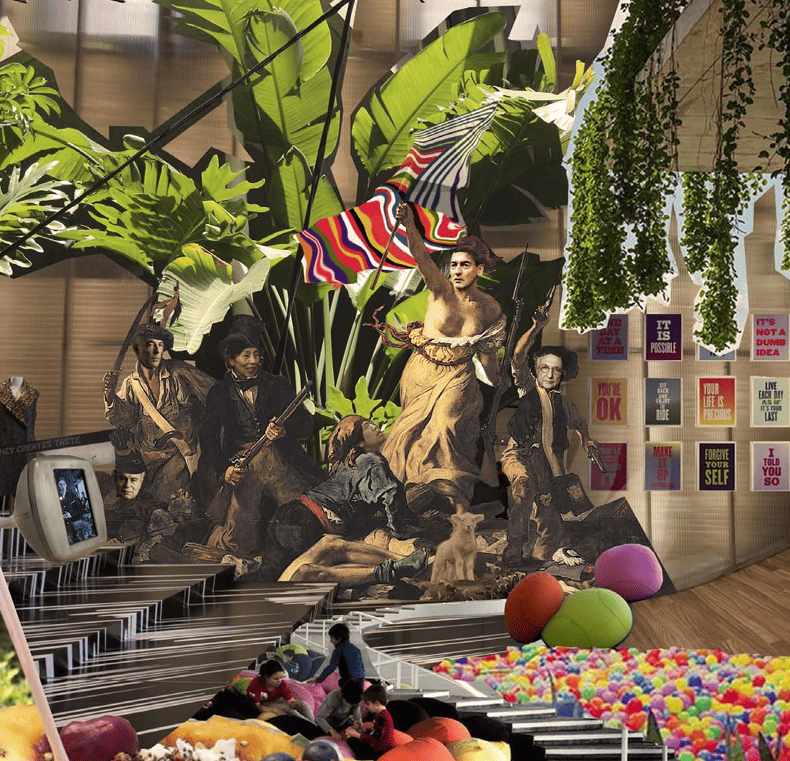
If neoliberal capitalism is increasingly capable of exploiting each individual’s freedom, and a substantial part of early 21st century’s prestigious architecture has been legitimized by an increased offering of freedom to its users, the question is unavoidable: does this offering respond —as dominant architectural discourses sustain— to a purely social, or even philanthropic will? Or, perhaps, is that offering the by-product of a capitalist system that needs to enable individual freedoms to guarantee its own reproduction and perpetuation? And, in any case, can new forms of individual constriction or subjection derive from this offering? This thesis aims to answer these questions and, more precisely, to approach a transversal theory where ‘illusion of freedom’ —as a unitary conceptual entity— stands as the main legitimation tool of an architecture that has proliferated under the episteme of neoliberal economic policy. The thesis is structured on five independent architectural episodes organized in terms of capacity, and anchored by, but not limited to, five categories of human experience: housing (House and Garden, Ryue Nishizawa); consumption (Prada Epicenter, Rem Koolhaas); leisure (1111 Lincoln Road, Herzog & de Meuron); learning (Rolex Learning Center, SANAA); and work (Facebook MPK20, Frank Gehry). Incrementally, the argument covers a spectrum that ranges from individual freedoms enabled for two people in a single house, to individual freedoms enabled for 2,800 people in a single office. Through issues such as the individualization of lifestyles, pre-structuring of agency, emotional involvement of consumers, spatial management of innovation processes, or corporate entrepreneurship, this work aims to address specific architectural resources that serve to legitimize the freedom of economic laissez-faire, and highlight new constraints upon the social subject derived from it.