Documentary Imagination: The Photographic Assemblages of Kenzo Tange, Kazuo Shinohara, and Kazuyo Sejima (1954–2004)
- Author: Rodrigo Rubio Cuadrado
- Type of research: PhD (Doctoral Thesis)
- Lines of research: Habitat and domesticity
- Director: Emilio Tuñón Álvarez
- Defense: 2023 March
We live surrounded by a seamless web of images. From the most private and personal, to the more anodyne or institutional, the thechnical image mediates and infiltrates all layers of our daily life. It promises us immediacu while concealing —stealthy and almost unnoticed— its subtle effects and displacements… and architecture is no stranger to this dynamic.
This thesis explores the role played by the photographic image in the renewal of the domesticity imagination in Japan during the second half of the twentieth century. It investigates the travels back and forth between physical and virtual architectures: the former built in stone, paper and wood —glass, metal and concrete, after that— and the latter imagined from a few lenses, emulsions and a lot of ink on paper: mere cut-outs or discrete tracings of the physical, that tend to travel and join forces with others building aggregates or book-images. Fanzines, photobooks and magazines that proliferate everywhere after World War II in Japan, articulating discourses, shaking consciences and mobilizing audiences.
The hypothesis is twofold. First, that these fanzines, photobooks and magazines are not simple passive warehouses, deposits or repositories but active projectual tools that operate as an atlas; “as orientation and assembly tables,” in Didi-Huberman’s words. And second, that these atlases do not operate in a vacuum, but responding to the logics and mechanisms described by Boris Groys’ double economy of the archive: the economy of innovation —which governs the exchanges between the space of the archive and the world of the profane — and the economy of suspicion —which describes the tense, quasi-paranoid relationship between spectator, medium and author.
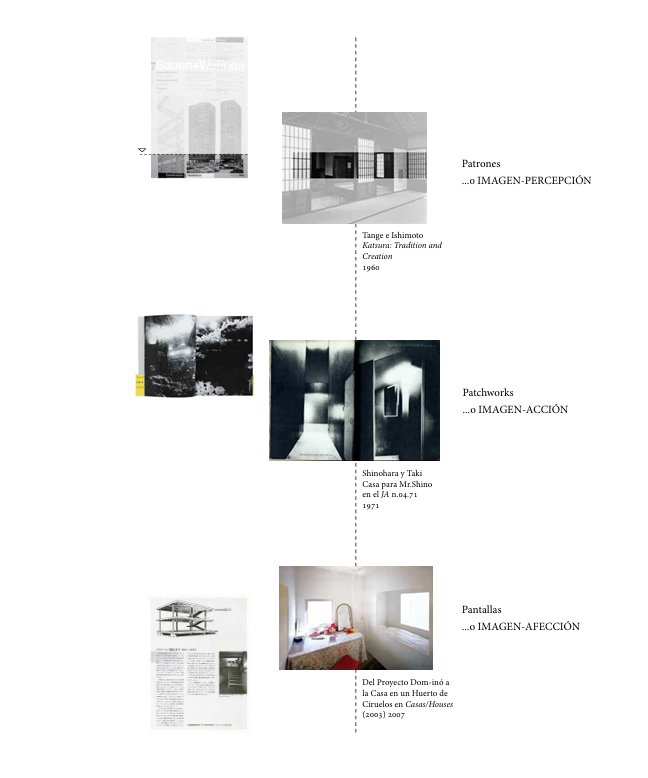
On this basis, we analyze Kenzo Tange and Yasuhiro Ishimoto’s cropping and dismantling of Katsura in the late 1950s; the on-the-move or accidental photography of 1960s Provoke fanzines, and its relationship to the work of Kazuo Shinohara and Koji Taki in the early 1970s; and finally the electronic image and digital composites in the work of Toyo Ito, the photobooks of Takashi Homma and Walter Niedermayr and their relationship to the books, images and architectures of Kazuyo Sejima, in the late 1990s and early 2000s. Three successive logics of montage —patterns, patchworks and screens— that end up estranging, renewing and intermingling both: the imaginary of the house and the imagination of the city.