Informal methods or forms in process: geometries of a collective unconscious
- Author: María Belén Granja Bastidas
- Type of research: PhD (Doctoral Thesis)
- Lines of research: New Design Tools, Roles and Pedagogies
- Directors: Miguel Martínez Garrido, Aurora Fernández Rodríguez
- Defense: 2021 March
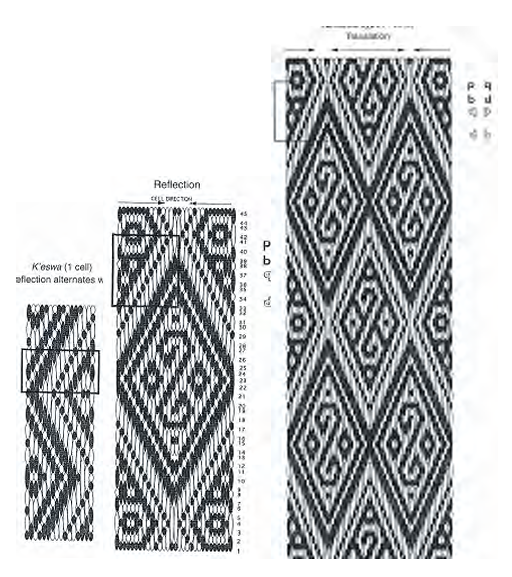
The formal or the informal, intuition or reason: a dual reality is what best defines Latin America in all its spheres. Two conceptual models are reflected even in the layout of our cities—“formal and informal city”—the former based on logical reasoning, the latter rooted in the concrete experience of inhabiting.
We trace the origin of this duality to art, where the figurative codes of “universal art” were imposed over the primary form of still-vibrant popular art of pre-Columbian origin: weaving. These textiles were relegated to the category of “craft,” and their “abstract” codes were considered primitive. This created an “official art” and a “marginal art.”
We propose that the patterns of textile geometries are “geometries belonging to a collective unconscious” and therefore have an impact on the construction of popular habitat. Thus, by correlating and understanding both what weaving represents in local popular practices and the processes by which the informal city is made and built, we can begin to identify some of these principles, structures, and combinatory dynamics as guidelines in the conception of architectural space in housing.
This, in turn, allows us to find a bridge of connection between the mechanisms of formal and informal composition. Although it may seem that the formal model operates from rational thought, the optical and the logical, and the informal from the constructive, haptic, and intuitive, we believe that both can be connected—geometry and mathematics serving as shared tools between them.