Pavements: Phenomenological Traces, Archaeological Records, and Planes of Reference
- Author: José Francisco García Sánchez
- Type of research: PhD (Doctoral Thesis)
- Lines of research: Spaces and Types, Masters and Rethorics
- Director: Luis Martínez Santa-María
- Defense: 2020 January
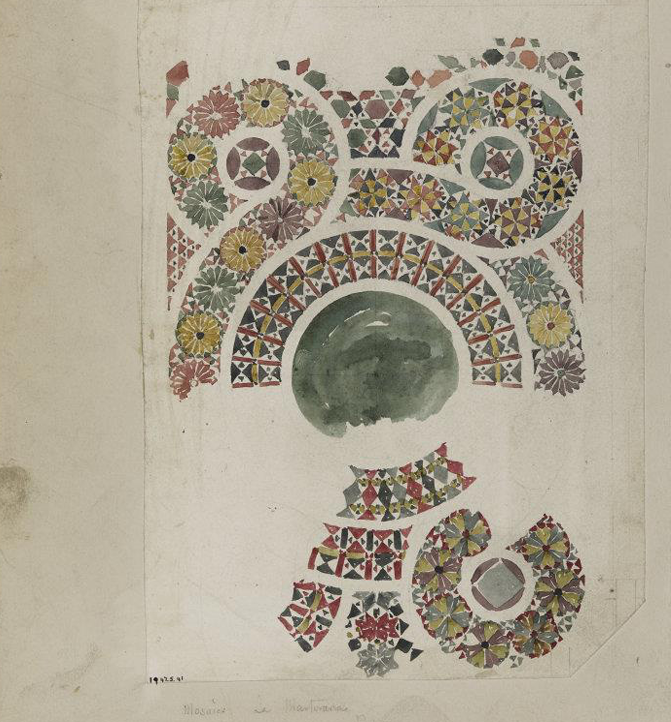
The thesis is defined as an illustrated history of pavements that reflects on the condition of the ground as a phenomenological trace, as an archaeological record, and as a reference plane. The text addresses the study of pavement as architecture of contact, as condensed architecture or in its infrastructural condition; and also in its spatial dimension, or in its formal composition.
The thesis constructs a comparative dialogue between different eras, establishing as a guiding thread the pavement and its relationship with the other elements that make up architectural space. The scope of study focuses on certain works of the twentieth century, encompassing some examples of orthodox modernity, but above all, selected works from the second generation of the Modern Movement.
The text analyzes how the paved ground becomes an element that participates in the genesis of the modern project, assuming its role as a bearer of a spatiality of its own. The paved ground can be considered as condensed architecture with its own spatial quality, since it is a surface that, in the absence of shelter, already presages a place. This idea of ground-as-space situates the plane of the paved floor in a dimension that goes beyond being a silent, static architectural element.
The thesis addresses, from a phenomenological standpoint, the intimate relationship we establish with the plane of the paved ground through touch—with the feet, with the hands, or with the body—but also through sight and hearing. The ground calls to us each day in its infinite extension, and we sometimes forget where our feet are placed. Pavements play a fundamental role in the perception of a place due to their texture, color, thickness, materiality, roughness, sound, or temperature.
The text defends the tactile sensuality of the ground in contrast to the strictly visual culture that the twentieth century, through the image, has tried to impose. It values the artisanal and popular construction of pavements over the universal industrial prefabrication. This affiliation with the erotic, the imperfect, and the coarse allows for an approach rooted in the human, as the ground can be considered a form of architecture of contact.
The thesis studies the condition of the paved ground as an archaeological trace. Every step on its surface refers us to a memory, to a recent past; and every new step presages an imminent future, an unexpected tomorrow. Movement across a pavement allows one to recognize oneself immersed in a field of play that establishes connections with both space and time.
The text examines the presence of pavement in the imagined space of painting, in photography, in literature, or in film; and analyzes the evolution of the graphic representation of pavement throughout history. From the emergence of perspective in the Renaissance, to the floors drawn in figurative painted space, to the graphic tools employed by modernist architects, artists associated with land art, abstract expressionism, or the graphic production of pop culture in the 1960s, among others.
The thesis is divided into two blocks. In the first ten chapters (Block I. References), reflections are developed around diverse themes related to the ground, with examples from all historical periods exploring different concepts: traces and memory, scale and form, drawing and representation, phenomenology and feet, body and pleasure, density and power, circles and landscape, communication and signals, inclination and nature, and carpets and superpositions. In the final five chapters (Block II. Case Studies), a critical analysis is conducted of certain twentieth-century works: Mies van der Rohe and the ground as a reference plane, Gio Ponti and the optimism of color, Carlo Scarpa and Venetian metaphors, Gunnar Asplund–The Smithsons and intermediate spaces, and finally, Alvar Aalto–Dimitris Pikionis and the archaeology of the fragment.
The format of the thesis is presented as an atlas of pavements, as interspersed among the essays are plates where a constellation of more than 3,000 images (collages) from various disciplines and origins support, through a visual language, the theoretical and critical discourse of the research. Therefore, the thesis is presented as a visual critical memory, a glossary to guide those who decide to design and construct contemporary architecture today.