Hybrid Actor and Consummated Object: Composition, Operation and Transformation of the Belgian Sawmill
- Author: Haitam Daoudi
- Type of research: TFM MPAA (Master’s Thesis MPAA)
- Lines of research: Digital Territories
- Director: Luis Rojo de Castro
- Defense: 2025 February
- Funding: Own funds
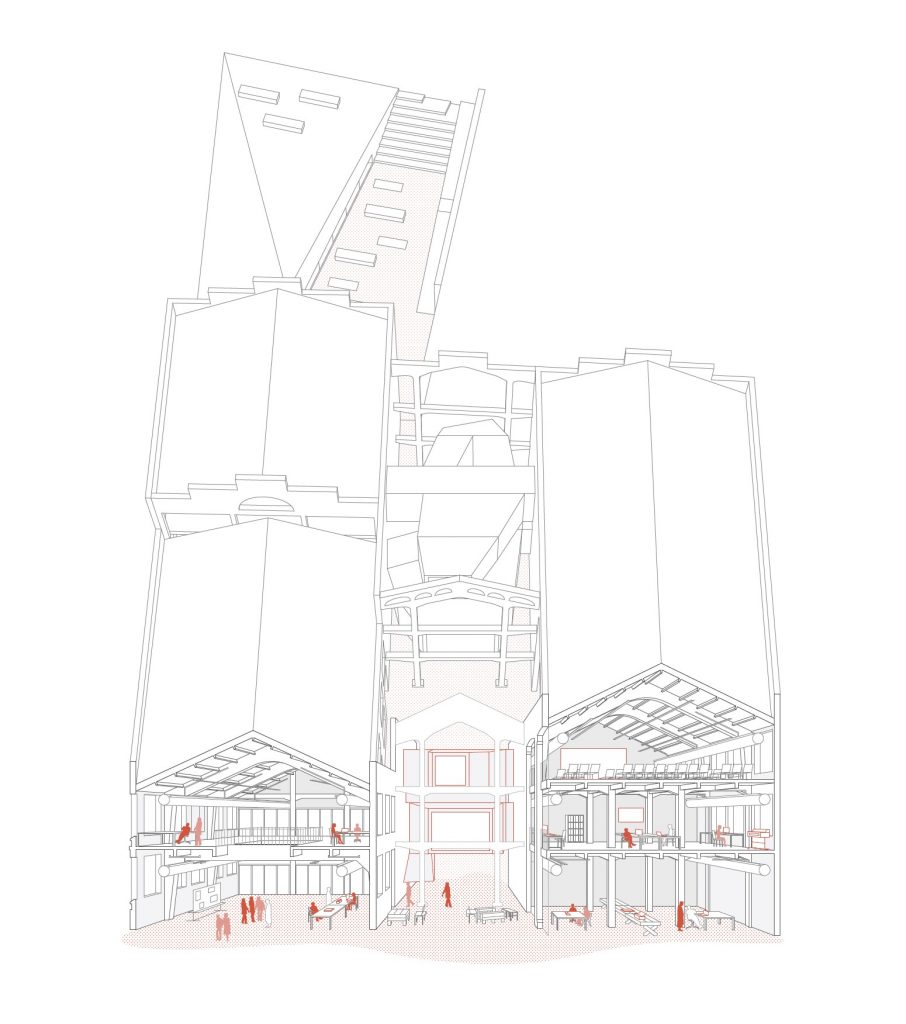
The investigation examines the transformation of the Belgian Sawmill in Madrid, first as Medialab Prado and later as Espacio Cultural Serrería Belga, to explore how architectural space mediates and is mediated by socio-technical networks, cultural programs and institutional frameworks. Against the backdrop of urban cultural policies and the growing influence of digital infrastructures, the thesis positions the Belgian Sawmill as a site where these aspects are being negotiated. Using theoretical tools from Bruno Latour, Albena Yaneva, Jeremy Till and Keller Easterling, the research positions architecture as a contingent, hybrid participant in shaping, and being shaped by, its broader context.
Medialab Prado functioned as a dynamic interplay of different kinds of interactions, mainly revolving around the convergence of the logics of the studio, the laboratory and the forum, blending physical and digital infrastructures to create a participatory platform for knowledge production and collaborative engagement. Its techno-digital program, far from being contingent on architecture, drove its configuration, shaping and amplifying the Belgian Sawmill into a mediator of relationships and actions. Medialab’s operation extended beyond the physical limits of the building, transforming it into a hybrid network that facilitated experimental practices across different sites. The transition to Espacio Cultural Serrería Belga, however, marked a recontextualization of the building, the goals of its program and its interaction with the users, within a new cultural agenda centered on the dissemination of curated content.
The thesis traces the transformation of the Belgian Sawmill and its associated programs, situating these shifts within broader trends in the digitization of spaces, the commodification of knowledge and the evolving role of architecture in mediating social and digital dynamics. It argues for an understanding of architecture as a contingent and evolving medium that negotiates between human and non-human actors, material arrangements and digital infrastructures, framing how architecture is contextualized within the information society.